





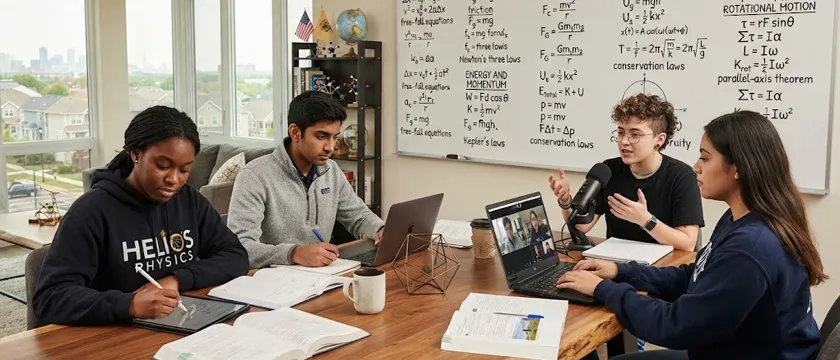
How Online AP Physics Tutoring Works for NJ Students
A beginner-friendly guide to finding an online AP Physics tutor in New Jersey — what the exam actually tests, how prep should be structured, and what to avoid.
The Complete Guide to Finding an Online AP Physics Tutor in New Jersey
AP Physics has a reputation problem. Students assume it's hard because the math is hard. In most cases, the math isn't the issue — the issue is applying concepts to problems that don't look exactly like the textbook example. That's precisely the gap an online AP Physics tutor in New Jersey should be built to close.
An online AP Physics tutor in New Jersey helps students prepare for AP Physics 1, 2, or C by teaching conceptual application, not just formulas, using practice problems structured like the actual exam format, with regular timed testing to build exam-day speed and accuracy.
What AP Physics Tutoring Actually Means
It's remote, live instruction focused on translating physics concepts (motion, energy, forces, circuits, etc.) into exam-style problem solving — the specific skill AP exams test, which is different from simply "knowing the formulas."
Key Facts
- AP Physics variants: Physics 1 (algebra-based), Physics 2 (algebra-based, thermo/fluids/E&M), Physics C (calculus-based, Mechanics + E&M)
- Format: live 1-on-1 or small batch sessions, 60 minutes typical
- Core skill tested: applying formulas to unfamiliar problem setups, not memorization
- Best prep window: starting review 3–6 months before the May exam date
Why This Course Trips Up Even Strong Students
Physics problems are rarely presented the way they're taught. A student can memorize F = ma perfectly and still fail a question that requires recognizing three separate forces acting on an object before applying it. AP exams are specifically designed to test this translation step — from real-world scenario to equation — which is exactly what most classroom teaching skips over in favor of formula drilling.
How Good AP Physics Tutoring Should Work
Step 1 — Diagnose conceptual gaps. Confirm the student understands the underlying physics, not just the formula, before moving to application.
Step 2 — Rebuild through visuals. Force diagrams, motion graphs, and circuit diagrams make abstract concepts concrete.
Step 3 — Practice with released exam questions. Nothing prepares a student for the AP format better than the actual style of question they'll face.
Step 4 — Time every practice set. AP Physics is as much a speed test as a knowledge test — untimed practice alone won't reveal this weakness.
Step 5 — Review free-response scoring. AP free-response questions are graded on specific reasoning steps, not just the final number — students need to practice showing work the way graders expect.
Who Should Get an AP Physics Tutor
- Students taking AP Physics 1, 2, or C for the first time
- Students who understand class material but underperform on timed tests
- Students self-studying without a formal AP Physics class at their school
- Students aiming for a 4 or 5 who need targeted practice beyond classroom pace
Benefits and Drawbacks
Benefits: individualized pacing through a dense syllabus, exam-format practice that classrooms often don't have time for, and flexible scheduling around a demanding course load.
Drawbacks: AP Physics prep requires sustained weekly commitment — cramming in the final month rarely closes conceptual gaps that built up over a semester.
Self-Study vs Classroom vs Online Tutor
|
Approach |
Concept Application Practice |
Timed Exam-Format Practice |
Individualized Pacing |
|
Self-study (textbook/videos) |
Low |
Low |
High |
|
School AP Physics class |
Medium |
Medium |
Low (fixed pace for whole class) |
|
Online AP Physics tutor |
High |
High |
High |
A Concrete Example
A student who can state Newton's second law but struggles on an incline-plane problem isn't missing the formula — they're missing how to break the problem into components (gravity, normal force, friction) before applying it. A tutor who spends a session purely on force-diagram practice, across five different problem types, closes this gap far faster than reviewing formulas again.
Alternatives
Students who are already scoring well and just want a final review before the exam may only need a short, intensive review course. Students with genuine conceptual gaps across multiple units benefit more from a structured multi-month program that builds application skills progressively.
Where AP Physics Prep Is Headed
As more NJ students take AP Physics without a strong in-school program behind it, demand is shifting toward tutors who can run a full mock exam under timed conditions — not just review sessions — since exam-day pacing is often the actual deciding factor between a 3 and a 5.
The Helios Science Approach
Helios Science's online AP Physics tutor in New Jersey program is structured around exam-format practice from day one: concept diagnostics, visual force/motion teaching, timed mock tests modeled on the real AP format, and free-response practice scored against actual AP rubrics — with progress reported to parents through the Helios Science app.
FAQ
When should a student start AP Physics tutoring?
Ideally 3–6 months before the exam, though even a few weeks of focused, timed practice can meaningfully improve exam performance.
Is AP Physics 1 harder than AP Physics 2?
They cover different content — Physics 1 focuses on mechanics, Physics 2 on thermodynamics, fluids, and electricity — difficulty depends more on a student's strengths than the course number.
Do I need calculus for AP Physics?
Only for AP Physics C. AP Physics 1 and 2 are algebra-based and don't require calculus.
How much does timed practice actually matter?
Significantly — many students who understand the material still lose points purely from running out of time, which only improves with timed mock exams.
Can online tutoring fully replace a school AP Physics class?
It can be used for self-studying students, but for students already enrolled in a school course, tutoring works best as a supplement focused on application practice and timed testing.
If exam-day pacing, not raw understanding, is what's holding a student back, that's the specific gap to mention when starting with a tutor — it changes how the first few sessions should be structured.
Mode of Contact: Call/WhatsApp +91 7470642700 · Email helios.science2018@gmail.com / info@helios-science.com


